The natural environment is a very important issue for us, our customers and stakeholders. Therefore, seeing negative aspects of the sector’s wastewater treatment performance in the spotlight has been enormously concerning.
Our vision is to be the leader within our sector for environmental performance for our customers and communities. We have ambitious plans for our coasts and rivers, with nine key pledges designed to improve the water environment and demonstrate our commitment to the highest possible environmental performance.
These can be found in ‘A vision for coasts and rivers’, alongside helpful information for customers and stakeholders on the current situation, investment plans and opportunities for the wider public to make a difference for our coasts and rivers. This was supported by nine pledges that will deliver water quality benefits and improvements for the environment of our rivers and coasts. We are pleased that Ofwat and other stakeholders have welcomed these as industry leading ambitions.

A vision for our coasts and rivers
The water environment is at the heart of everything we say and everything we do as a business.
Find out moreOur commitment to the environment is demonstrated in our performance, where we have achieved several significant successes towards this, including:
- We achieved a three-star “good company” rating in the Environment Agency’s 2023 Environmental Performance Assessment, maintaining that standard from 2022.
- The Environmental Performance Assessment results also showed that we had had no serious pollutions in 2023, and indeed since 2021. This assessment highlighted us as “one of the better performing companies on this metric”.
- Our work has also contributed to 32 of the North East’s 34 designated Bathing Waters achieving the top ratings of ‘excellent’ or ‘good’ in Defra’s most recent classifications (in 2021), up from 26 in 2013.
- We also have an ambitious goal to achieve net-zero (Scope 1, 2 and 3 emissions) by 2050. During the past 15 years we have reduced our Scope 1 and 2 emissions by over 90%.
- This has all been achieved while offering our customers the lowest wastewater bill in England.
However, we are not complacent, and we know we must continue to do more to support the natural environment.
Environmental compliance at Wastewater Treatment Works
Background
In November, we, along with all other wastewater companies, were contacted by the Environment Agency (EA) and Ofwat about measures to ensure permitted ‘Flow to Full Treatment’ requirements are being achieved at our Wastewater Treatment Works. This was followed by a further request from Ofwat in March 2022, more information on which is outlined below.
Flow to Full Treatment (or FFT) is a measure of the maximum flow a wastewater treatment works is designed to treat.
When wastewater treatment works are built, they are designed to meet a ‘flow’, the volume of water going through the works. The Environment Agency, our regulator, requires water companies to design wastewater treatment works ‘to treat peak dry weather flow and additional flows from light rainfall’.
This involves calculating the dry weather flow (DWF), which helps us understand the minimum volume the plant will need to treat during a period without rainfall. The DWF is then used as a base to help calculate the FFT level that meets the regulatory requirements. This means every treatment works has a unique FFT value. In some cases, this value is included in a permit from the Environment Agency with which a water company must comply. Across our 410 wastewater treatment works, there are 189 which are permitted with an FFT requirement.
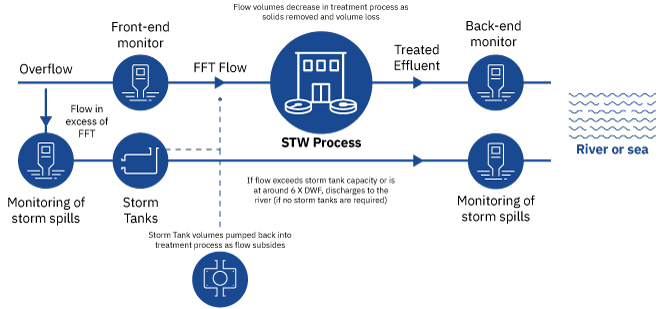
While the precise circumstances can differ at individual treatment works, a system is normally designed to treat a flow volume of around three times the maximum dry weather flow (DWF). If this flow is exceeded, for example, by a storm event, snowmelt or flooding draining, then flows in excess of the FFT level are diverted.
This can either be:
- to large tanks where the flow is stored until the storm subsides. When the flow into the works reduces after the storm event has ceased and treatment capacity becomes available, the contents of the storm tanks are returned to the inlet to the works to pass through the treatment process.
- Or, to an overflow on the works, which is usually set to spill over directly to a watercourse when the flow exceeds around six times DWF.
This means that, even if sites were not compliant with FFT, this is unlikely to create any harmful spills to the environment - in most cases, the flows would be diverted to storm tanks and then passed back through the treatment process.
When treatment works were first built, they were designed and engineered to a specific capacity to achieve FFT levels. At the same time, the staff operating these sites will monitor their performance and take corrective action to maintain them, ensuring that they continue to operate effectively. Finally, compliance is also checked externally by our regulators through periodic site visits and assessments.
As part of the industry’s Water Industry National Environment Programme (WINEP) work between 2020-25, an extensive investment programme is underway to improve this monitoring and install MCERTS (the EA’s Monitoring Certification Scheme) approved equipment.
Monitors currently installed can either be at the ‘front-end’, or ‘back-end’ of the treatment works. Front-end monitors' will typically compare information on flows directly to FFT permit requirements. They monitor the flows coming into the ‘front’ of a treatment works at a set time before elements are removed or filtered out in the treatment process. ‘Back-end’ monitors instead look at the volumes leaving the site post-treatment.
Every site has its specific process, equipment and procedures and will treat a varying volume on different days; all of this leads to a length of time for water to pass through the treatment process, and it is very difficult to accurately extrapolate from a back-end monitor what flows were coming into the works at a set point in time.
We are investing £45.56 million in flow measurement schemes up until 2025. This will give us much greater coverage of MCERTS front-end monitoring. We have completed investigations on whether we can install the same monitoring to additional sites for completion between 2025 and 2030.
Our regulators are seeking specific information as part of a cross-industry investigation to check our compliance with a specific aspect of our environmental permit conditions relating to discharges and our related statutory and licence duties. We provided extensive information to the EA and Ofwat in November and December last year.
The water industry, EA and Ofwat have worked closely together to tackle the challenges presented by discharges by developing the Water Industry Natural Environment Programme (WINEP). Investment is allocated between 2020-25 as part of the current business plan period. We are installing new monitoring equipment as agreed with Ofwat and the EA. We have been following a clear plan to address any issues that arise and continuously improve on assuring our environmental performance.
In early March 2022, Ofwat issued a formal notice (a Section 203 notice) requiring us to provide further information with a deadline for submission in early April. This notice is a formal investigatory step and indicates that Ofwat will carefully consider the information in light of our legal obligations. It does not necessarily imply that any enforcement action will follow, but it is a more formal process.
We recognise the issue’s importance to our stakeholders and customers and the gravity of the investigation. We fully complied with the requirements to provide information by submitting our response in April, taking the opportunity to demonstrate to Ofwat that we take our responsibilities very seriously.
We have also subsequently provided an update to Ofwat on our progress which remains on track.
In July, we met with Ofwat to discuss our responses to their investigation. As a result of this meeting Ofwat sent us two sets of follow-up questions and we have fully responded to these. We are pleased that Ofwat has “recognised and welcomed our transparency” in these exchanges of information and in our approach to the investigation in general.
In July we received a further information request from Ofwat in relation to our sewerage system in the Whitburn area. Again we responded fully: describing in more detail how our spill reduction scheme in the area had been designed; providing evidence that recent spills in the area had been due to rainfall; and providing further evidence that reducing spills in the Whitburn area had had no detrimental effect on spill numbers further downstream in our sewerage network. To give further transparency we supplemented this response by arranging for the Ofwat Investigation team to undertake a site visit.
We understand that Ofwat continues to move towards its reporting/conclusion stage of the investigation for NWL, however in the meantime we will endeavour to respond fully to any further information requests should any arise.
March 2023 - June 2023
We continue to respond fully to further information requests from Ofwat received in May and June. These requests related to:
- Obtaining updated/appropriate environmental permits following detailed checks undertaken by NWL which had identified c58 points across some 30,000km of our sewer network where a discharge of wastewater could take place during rainfall but which didn’t have the appropriate permit documentation. In all cases the correct permits have now been requested from the EA.
- Further information in relation to independent checks of FFT compliance undertaken for us by Wood Group at all relevant sites. This work has now been completed and has identified no further potentially non-compliant sites.
- An update on work being undertaken by NWL to investigate a number of ‘foul only’ sewage pumping stations which should not receive storm water/rainfall but nevertheless appear to show higher flows during rainfall. We are checking these carefully to ensure there is no risk of an unpermitted discharge.
- More information on the ongoing checks and adjustments we are making at our wastewater sites on an ongoing basis to ensure that compliant operations are maintained over time.
- Further information in relation to a spill reduction scheme in the Whitburn area which was completed in 2017/18.
We understand that Ofwat continue to move towards its reporting/conclusion stage of the investigation for NWL, however in the meantime we will endeavour to respond fully and transparently to any further information requests.
December 2022 – March 2023
In early January we responded fully to a further data request from Ofwat (received December 2022). This related to wider aspects of environmental compliance at Sewage Treatment Works, looking much broader than FFT compliance.
This submission to Ofwat was followed by a further meeting on 24 January. After the meeting Ofwat set out some follow-on questions, to which we responded fully on 10 February.
We understand from the meeting that Ofwat is now collating its conclusions and corresponding report on this investigation.
In the meantime, we continue to monitor and scrutinise our compliance very carefully as part of our normal practice.
September 2022 – December 2022
We met with Ofwat over the summer and they noted in their discussions with us that they ‘welcomed our transparency’ on this issue and that they were ‘broadly satisfied’ with our action plans and response.
Having fully responded to the two further information requests from Ofwat over the summer, by September there were no further actions required of us by the regulator in relation to the investigation and we had completed all the near-term actions that we set out in our action plans in April.
Given this position, we wrote to Ofwat in September to ask them to articulate their outstanding compliance concerns or, if they were satisfied with our position, what the process was to conclude their investigation. Ofwat advised that they could not conclude the investigation highlighting that they needed to thoroughly assess all of the information they have had to date from companies as well as other sources of intelligence but did not set out any further concerns or timescales.
At the end of September we received a letter, which was issued to all companies, in relation to compliance with requirements for pollution reporting. We responded in full on 19th October setting out a robust approach to reporting of potential pollution incidents. A copy of this letter can be found here.
The next communication we received from Ofwat was in December, when we received a further data request relating to wider aspects of environmental compliance at Sewage Treatment Works - this request was much broader than FFT compliance. We are currently collating the required data in order to respond in January 2023.
Meanwhile we continue to monitor and scrutinise our compliance very carefully as part of our normal practice.
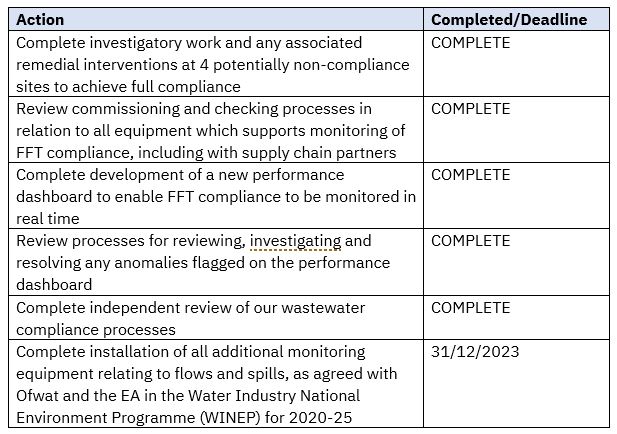
A summary of actions completed and in progress is provided below:
July 2022 – September 2022
Following completion of the work, we have engaged with consultants to independently assure the compliance of these works. This has required periods of sustained wet weather to confirm that each works is treating the required volumes before any spills occur. This has now been completed and all four of the sites are compliant.
While these works have been completed and compliance verified on the four named sites, we will continue to scrutinise compliance with our environmental permits at all sites. Likewise, where some non-material areas for continuous improvement have been identified, we will be taking these forward internally. We will continue to update customers and stakeholders appropriately.
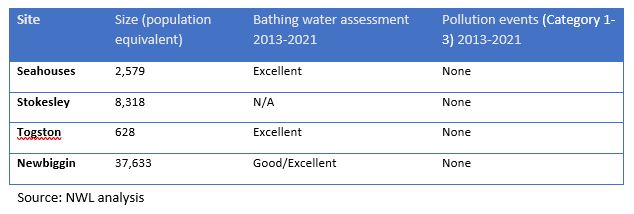
We are very disappointed to have identified the risk of potential noncompliance with the FFT permit requirements at these sites. However, we can find no evidence of any material impact on the environment. The table below shows how the impacted supply areas have had no serious pollution events since 2013 and where appropriate bathing waters have been assessed at least as Good, with all now Excellent.
We have looked closely at our performance, monitoring systems, and standard operating procedures as part of this process. As a company committed to constantly improving our environmental performance, we will continue to update and improve these procedures.
We have found several areas where operational improvement may be possible for sites already compliant with their permit, further improving performance beyond the requirements for environmental benefit, and are implementing this as appropriate. This has included:
- Improvements to reporting internally of spills, including a senior level monthly review.
- A new trigger process for immediate investigations into any site that shows a risk of non-compliance.
- Increased data transparency planned for customers and stakeholders in line with our pledges.
- Regular updates on this specific topic and increased opportunity for scrutiny from our Water Forums, a Customer Challenge Group.
- Further investment in new monitors across sites beyond our committed projects in our Business Plan.
We have also completed a full review of our wastewater compliance assurance processes conducted by an independent company. This assessed the full breadth of our wastewater compliance obligations across nine key areas. Each area was assessed against four criteria:
PLAN: Do we fully understand each obligation and how it related to our assets and operations
DO: Do we have the right data to understand our current level of compliance
CHECK: Is the data made available to the right people in an understandable format
ACT: Is there a clear process for taking preventive action where the data warrants it, in order to maintain compliance
The review hence made an assessment of 35 aspects of our approach to wastewater compliance (9x4 less 1 n/a) and concluded with a “green – No gaps identified” assessment in 22 areas, a “yellow – no material gaps but suggestions for further improvements made” in 12 areas, and 1 area assessed as “amber” where work is already in progress.
As the majority of findings from this review were not material, we will progress these as business as usual.
We have now completed all of the short-term actions in our action plan, as agreed with Ofwat, as well as having resolved the issues identified at the four sites, as outlined above.
There are some longer-term actions, to install additional monitoring at our wastewater treatment sites. The schedule for this work has been agreed with the Environment Agency and we are on track to deliver this within those timescales.
January 2022-June 2022
Our investigations have shown that overall, across the 189 locations where we have these permits, we identified circumstances where we may not have always achieved the required FFT levels at four smaller sites. We have reacted swiftly to address this, investing in new equipment and improved processes to remove the risk that these four sites were not fully compliant. The sites affected and the actions taken are outlined below:
- Seahouses Wastewater Treatment Works, which serves 2,579 customers, where we installed extra pumps in late March, which brought the works into full compliance.
- Stokesley Wastewater Treatment Works, which serves 8,318 customers, where it appears grit and silt have penetrated part of our system, reducing the available flow. We have corrected this issue and brought this into full compliance by May 2022.
- Togston Wastewater Treatment Works, which serves 628 customers, where we are assessing the effectiveness of recently installed new pumps along with checking for any further hydraulic restrictions on site. This was completed at the beginning of June 2022.
- Newbiggin Wastewater Treatment Works, which serves 37,633 customers, has a unique system for pumped inlet flows. Analysis indicates that it is inconsistent in being fully compliant. We optimised site settings and controls, which enabled us to move the site to consistent and full compliance and supplemented this with a hydraulic study of the site, all completed with the site in compliance in June 2022.
On 6 August 2024, Ofwat proposed a £17m fine for Northumbrian Water Limited, alongside fines for Thames Water and Yorkshire Water Limited.
We have been working through this ruling and have today responded to Ofwat, Tuesday 10 September 2024.
We will continue to keep customers informed on this page.
Introduction
In June 2025, as an alternative to paying a fine, we entered into an ‘undertaking agreement’ with Ofwat in which we committed to:
- Making a series of additional investments related to the environment, by way of redress for customers and to be fully funded by NWL – not through customer bills.
- Producing and delivering a set of 3 action plans, focused on reviewing (and where necessary improving) our approach to managing key aspects of environmental compliance.
The advantage of this approach is that the money which would have been used to pay the fine, is instead utilised to deliver additional improvements.
Here is an update on these activities.
Investment Package
In line with our vision for Coasts and Rivers, (more details of which can be found here: A vision for our coasts and rivers) we have committed to a redress package containing £15.7m of investments targeted at improving the health of our rivers and beaches. This investment package has been agreed with Ofwat and will be fully funded by NWL - not by customers.
The key aspects of this investment package are as follows:
Additional Flow Monitors
An investment of £3.4m to be made in the installation of flow monitors at 19 additional sites. These flow monitors are important to enable Flow to Full Treatment (FFT[1]) compliance to be assessed more accurately. They would originally have been installed in future investment periods and funded through customer bills, but now their installation has been accelerated and funded by NWL. The monitors are now all installed and operational, with a small amount of reinstatement work left to complete.
Tyneside Smart Network
We are investing in a Smart Sewer network to reduce storm overflow spills in the Tyneside area. As a result of the undertaking, £8.3m of this investment will now be funded by the company – as opposed to through customer bills. This investment is utilising industry leading technology to manage the flows of storm water through our network in order to minimise spills. It consists of:
Installing around 800 additional sensors across our Tyneside network, so that we better understand how much storm water is flowing through each part of the network, and in turn how likely it is that spills will occur.
Establishing a number of ‘control points’ in the network, which will enable us to speed up or slow down the flow of storm water (or send it in different directions) – along with establishing power supplies to these control points, along with the means to operate them remotely.
Building a ‘digital twin’ of the network – this is a computer model of the network, into which we feed both rainfall data and the data from the new sensors. The digital twin then ‘learns’ exactly how our network responds to rainfall of different intensities in different locations.
This enables the final stage of the project, where the digital twin will analyse forecast rainfall data, and configure the network – via the control points – to manage the flows of storm water in the optimum way to reduce spills.
The project is on track, with all sensors now installed, and good progress being made on the other elements. We expect the project to complete in 2026/27, and then in future we intend to rollout the same approach to reduce spills in other areas.
Additional Investment in Storm Overflow Spill Reduction
We are also planning to invest an additional £2m in storm overflow spill reduction at other sites – again to be funded entirely by NWL. This is in addition to the substantial investment already planned in this area for 2025-30. We have now identified a short list of sites at which to make this investment, and our project plan indicates this will be completed by March 2030. We will provide more detail on specific sites in future updates.
Additional Contribution to Our Branch Out Scheme
NWL’s Branch Our Fund allows local communities, land managers, other organisations and individuals to bid for funding for schemes to improve the natural environment – this supports broader environmental improvement schemes which would typically not form part of NWL’s business as usual activities. As part of the undertaking, we have committed to making an additional £2m donation to this fund across 2025-30, to significantly increase the number and scale of projects which we can support.
More details of our Branch Out fund can be found on our website here: Branch Out.
Our Branch Out scheme supports projects that reconnect habitats for the benefit of people and wildlife, building resilience to our regions whilst bringing benefits to water, wildlife and communities.
The first 3 schemes enabled by this additional funding are now in delivery and are as follows:
- Woodburn Farm Woodland Creation – This project focuses on planting around 2.34 hectares of woodland. This work will enhance biodiversity, reduce soil erosion, and improve water quality. The project also contributes to greater habitat connectivity and resilience within the catchment.
- Bradley Burn Farm Woodland Creation – This farm includes a section of the Houselop Beck which is currently of poor ecological status linked to agricultural pressures. The project will deliver 0.58 hectares of new deciduous woodland which will help reduce erosion and sediment loss to the watercourse, improve water quality and connect fragmented habitats.
- Let the Meadows Bloom (Rainton Meadows) – This project focuses on creating and enhancing species‑rich meadow and habitat areas to support a wide range of priority species. The project contributes to increased biodiversity, landscape resilience, and long-term ecological recovery across the catchment
We also have a pipeline of potential additional schemes which we are currently assessing.
Finally, given the increase in scale of this initiative, we are strengthening the associated governance arrangements, to ensure that this investment continues to be made in a fair and transparent manner.
Action Plans
Action Plans 1 and 3 – Improving Our Approach to Managing the Compliance of Our Wastewater Treatment and Network Assets
These action plans focus on reviewing (and where necessary further strengthening) our approach to:
- Making best use of data to understand any compliance risks
- Investigating any risks in a timely manner
- Where needed, putting interventions in place to address any risks
- Ensuring we have appropriate oversight from our Executive Leadership Team and Board
These action plans cover reviewing our approach to the following aspects of compliance:
- ‘Flow to Full Treatment Compliance’ – this was the original focus of Ofwat’s investigation and is described in more detail in previous updates. It ensures that storm overflows at our Wastewater Treatment Works (WWTWs) only spill when these sites receive excessive flows of storm water.
- ‘Spill Frequency Compliance’ – this is aimed at ensuring that out Storm Overflows more generally do not spill excessively – and that we identify and implement any cost beneficial ways of reducing spills.
- ‘Flow Passed Forward Compliance’ – This is similar to Flow to Full Treatment compliance – but for overflows located on our sewer network.
- ‘Dry Day Spill Compliance’ – ensuring that our storm overflows only spill due to rainfall i.e. not on ‘Dry Days’ and fully investigating any instances where this does occur
- ‘Dry Weather Flow Compliance’ – this focuses on ensuring that our WWTWs are sized correctly to meet the needs of our catchments and the number of people in them – and that any changes (for example if more houses are built) are managed appropriately.
- ‘Storm Tank Capacity Compliance’ – a number of our sites have storm tanks which can hold storm water for a period of time to minimise spills – this aspect of compliance focuses on ensuring these tanks are sized appropriately.
- ‘Emergency Overflow Compliance’ – this ensures that our Emergency Overflows only spill when they are permitted to.
- ‘Pollution Incidents’ – our approach to managing and minimising pollution incidents can be found in more detail in our Pollution Incident Reduction Plan(PIRP)
- ‘EDM Operability’ – we have Event Duration Monitors (EDMs) installed at all storm overflows to detect spills. This aspect of compliance focuses on ensuring that these monitors are fully operational for the majority of the time.
Some of the key improvement actions we are taking are:
- On Spill Frequency Compliance, the Environment Agency set out an updated framework to follow (the Storm Overflow Assessment Framework v2) in March 2025. This requires us to investigate a significant number of overflows to seek any further ways to reduce spills. We aim to complete these investigations by the end of 2029/30.
- On Flow Passed Forward and Emergency Overflow Compliance, we are installing additional monitors at our Sewage Pumping Stations and Emergency Overflows, so we can measure compliance more accurately.
- On Storm Tank Capacity, we are committed to undertaking a regular (annual) review of all tanks, to ensure they continue to be sized correctly.
- Our response to Pollution Incidents is set out in more detail in our PIRP – link provided above.
- On EDM operability we are continually reviewing and improving the technology used to monitor spills and communicate the results back to our information systems.
- More holistically, we are improving our information systems to give us a consolidated view of compliance across each of our catchments – which we will use to identify any priority areas for interventions.
- We are also reviewing and extending the level of information which we provide to our Executive Leadership Team and Board on these topics, and we have also introduced mandatory compliance training for all employees.
We will provide more detail in future updates as these activities progress.
Action Plan 2 - Further review of Assets in the Whitburn Area
The performance of our sewerage assets in the Whitburn area continues to attract significant interest from local stakeholders.
Following a ruling by the Court of Justice of the European Union in 2012, an improvement scheme was agreed with the Environment Agency and delivered and subsequently signed off in late 2017.
Given the continued local interest in these assets, we are committed to undertaking a further study in the area to re-assess the performance of these assets and any impact they may be having on the local environment, and in so doing establish whether there are any other cost effective interventions which we can make to reduce storm overflow spills.
The study intends to make use of an updated methodology from the Environment Agency, which will describe a best practice approach to assessing environmental impact specifically at coastal sites such as these. We expect this methodology to be available in late 2026.
The key steps in this study are as follows:
- By end 2026 – review and improve our ‘hydraulic models’ of assets in the area – to improve our understanding of how we expect these assets to respond to rainfall.
- By early 2027, we will have completed a review to identify any shorter ‘optimisation’ opportunities which could be used to improve the performance of the assets in the area in the short term, prior to the main study completing.
- By end 2027, complete an assessment of environmental impacts and possible interventions (using the EA’s new methodology) and establish next steps.
We will provide more detail in future updates as these activities progress.
Further Updates
We will provide further updates on these investments and action plans on our website every six months.
Keeping you informed
We are engaging directly with stakeholders at our sites where we plan investment to ensure compliance with a permit at a Wastewater Treatment Works. We will update customers and stakeholders as we complete further investments and investigations to confirm all sites are in compliance with environmental permits,
We have also published a new report and plan, ‘Our vision for coasts and rivers’, which brings together all of our work to date, plans up to 2025, and a longer-term, more comprehensive plan for meeting customer and stakeholder expectations on the broader issues of Storm Overflows, water quality in our rivers and reducing pollution.
We have maintained regular conversations with our Water Forums as representatives of our customers. As these investigations continue, we will regularly update these pages for our customers and stakeholders.
In line with our continued commitment to leading environmental performance, we will work with our regulators, customers, and stakeholders to swiftly resolve any issues arising from this process.
If you would like to contact us to find out more about these issues or have any questions, please email externalcommunications@nwl.co.uk